Creative collections · 7 October 2026
Beyond the grid: three creative photo collections
One larger photo, a softer corner, a small tilt: a few deliberate choices can give a collection its own character. These three Stickerloom examples show where to start.

1. Hero & echoes
Choose this arrangement when one photo deserves the first look: a favourite pet portrait, a birthday moment or the best image from a weekend away. Five photos are enough. A large frame establishes the focus; smaller companions make the collection feel connected.
On a 254 × 254 mm page, our main puppy uses a 112 × 102 mm rounded rectangle, rotated −9°. Place it left of centre. Above and to its right, add a quiet, upright 66 × 44 mm rectangle. That straight edge gives the eye a resting point among the tilts.
Continue down the right with a 54 × 67 mm archway at +9°. Finish below the hero with a 50 × 60 mm rounded portrait at −7° and a 57 × 62 mm rounded frame at +7°. Move each frame manually, leaving visible background between them. The ink-blue background helps the lighter subjects stand out.
Inspect each crop before settling the arrangement. In our example, the side-profile dog’s muzzle sits close to the archway edge. With your own photo, try another shape or adjust the framing if a nose, ear or other detail needs more room.
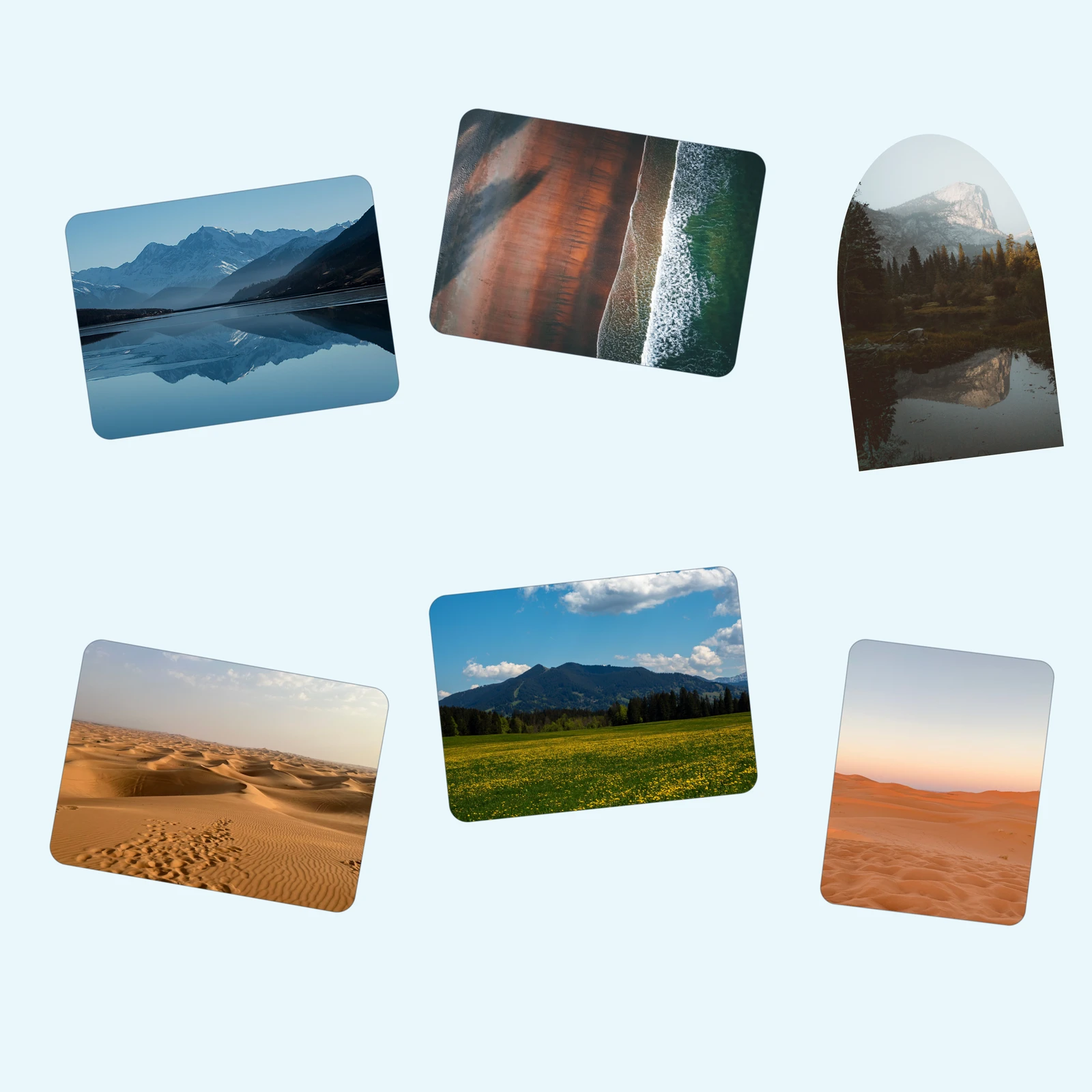
2. Soft-frame collage
This is a useful starting point for a travel collection with both wide views and taller images. Let the source photos suggest the proportions: a lake can stretch across a landscape frame, while a vertical mountain scene can sit in an archway.
Use the same square page with a pale sky background. Start with four 72 × 53 mm rounded rectangles, one 48 × 76 mm archway and one 48 × 62 mm rounded rectangle. Arrange three across the upper part of the page and three below, moving the centre frame slightly higher in each row.
Reading left to right across the top, then the bottom, our angles are −8°, +9°, −7°, +10°, −6° and +7°. Keep the spaces generous: rotation makes a frame occupy more room than its upright width and height suggest. Check the corners after every move. A tilted horizon can be playful, but reduce the angle if it distracts from the landscape.
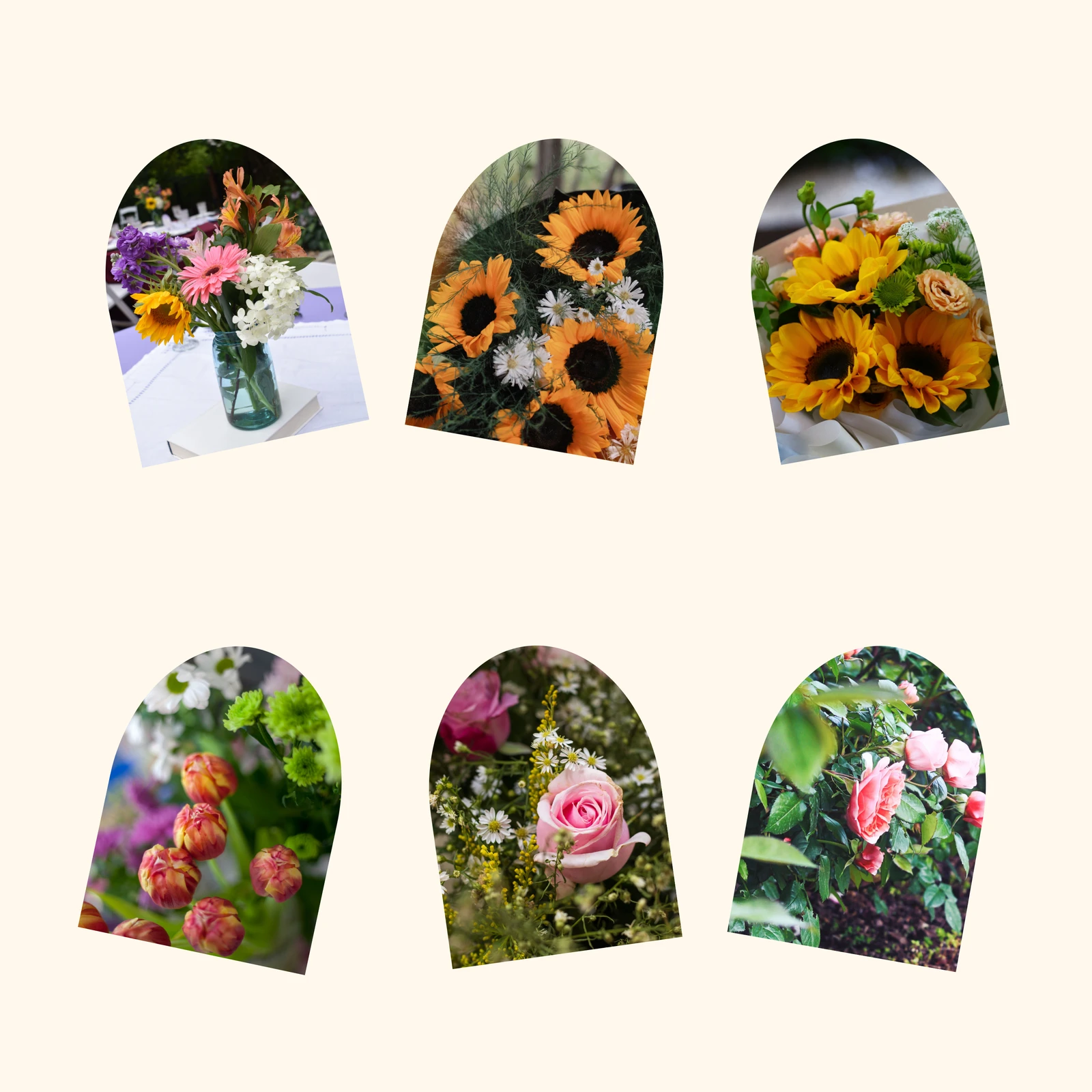
3. Tilted archways
For a set with a shared subject, try repeating one shape. Here, six flower photos use identical 54 × 72 mm archways on a cream 254 × 254 mm page. The curved tops bring continuity even though the bouquets differ in colour and scale.
Begin with two rows of three. Position the frames evenly while upright, then apply −12°, +10° and −10° across the top row; +12°, −8° and +10° below. Move them apart where needed after rotating. Keep enough cream space around the outside to make the arrangement feel settled.
Review the flower heads and stems inside every arch. Repeating the frame does not make every source photo crop alike; a close-up rose and a tall vase may need different framing adjustments.
Make the arrangement your own
These are manual editor recipes, not automatic presets. Use the full editor on desktop or a large-screen tablet for these finishing adjustments. The whole photo and frame tilt together. Start upright, choose the crops, then rotate and reposition; save a version before experimenting so you can compare the change.
The artwork shown here comes from actual Stickerloom PNG/PDF exports. Check your finished file in the format you plan to use, paying attention to crop edges, frame spacing and source resolution. For a physical print, make a proof with your chosen paper and printer; an attractive screen preview does not establish the printed result.
For more starting points, read the photo collage maker guide, or see how larger collections differ in 100 photos, four layouts.
About these examples and photo sources
These examples use real Stickerloom exports and stock photos from Pexels. The displayed images are web-sized versions of the saved 300 DPI PNGs. Photo sources:
Hero & echoes: border collie puppy, golden retriever puppy, side-profile puppy, orange kitten and pet rabbit.
Soft-frame collage: mountain lake, sea and coast, forest lake, desert dunes, mountain meadow and dunes beneath the sky.
Tilted archways: flowers in a vase, sunflower bouquet, sunflowers and roses, spring bouquet, roses and daisies and garden roses. See the Pexels licence for use terms.